

Enameling 101
Vitreous enamel is powdered glass fused onto metal in a kiln. Start here for what belongs on the bench, how a first firing goes, and a map of the techniques: cloisonné, champlevé, basse-taille, grisaille, and plique-à-jour.
Pictured: bowls of enamel powder and fired copper discs; Marian Slepian, cloisonné wall hanging “Opera Il Trovatore”; Joan Mackarell, champlevé “Memory Box”; a basse-taille pendant; a grisaille plaque; a plique-à-jour bowl; a Hot Shot kiln.
Enameling is glass fused onto metal. The powder looks like fine sand until a kiln or a torch takes it to about 1,000–1,600°F; when it cools, the color is in the surface. It will not peel like paint, and it will not fade the way a dye does.
After that, the craft is choosing a metal, a powder, and a technique that match the piece you want to make. This page is the front door. The articles under the Enameling 101 menu go deeper into each technique; the shop is where the jars, copper, foils, sifters, and kilns actually live.

View Vintage Thompson 676 Red
What you need on the bench
You need metal, vitreous enamel, and a way to heat it — and then patience.
Most studio work starts on copper. We cut circles, squares, and findings, and we carry stamped forms, hand-spun bowls, and laser-cut shapes. Silver and gold wait until you know how a color behaves. Metal foils go under transparent enamel when you want light bouncing back through the glass. If you would rather skip fabricating the first piece, start with ready-to-enamel jewelry.
We are not a manufacturer — we stock the widest range we can find: pre-1990 vintage Thompson (the leaded line people still talk about), plus Milton Bridge, Blythe, Schauer, Ninomiya, Hirosawa, and W.G. Ball — leaded and lead-free, opaque and transparent, lump, frit, and 20 mesh. If you want to learn a family before you buy jars, start with a sample kit.
You also need heat, and a way to put powder on the metal: sifters in several meshes, flux for copper or silver, and a Hot Shot kiln if you do not already have a furnace. Books and small tools live under tools and supplies.

View Copper Shapes
A first firing, without the mystique
Buy enamel already ground, or crush lump enamel until it is finer than sugar and coarser than flour. Dust it — or wet-pack it — onto clean metal, fire until it flows, and let it cool. Then you can add another color. Some pieces are done in two firings; some take ten.
Flux is the clear coat that helps color bite on copper. Lead-free lines do not always fire like the old Thompson leads, which is why people still reach for the vintage jars when they need a particular red or a particular transparency. We carry both. Read the jar, test a scrap, and keep notes — that habit will save you more grief than any recipe.
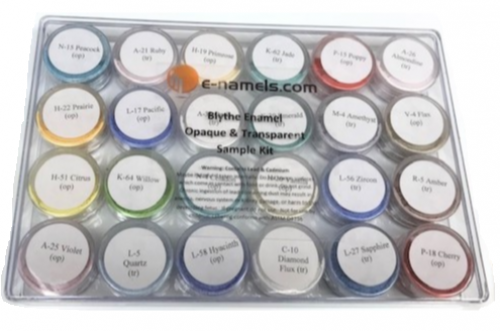
View Blythe Sample Kit
Techniques — pick one and go read it
Each of these has its own page. Use the list as a map, then go read the one that matches the piece in front of you.
- What is vitreous enamel? — the glass, the metal, the firing range, and a short history.
- Cloisonné — fine wires form cells; you fill each cell with powder and fire in layers.
- Champlevé — the opposite of cloisonné: you gouge the metal and fill the hollows. Thick copper is the usual base.
- Basse-taille — low relief under transparent enamel, so light bounces off the carved metal.
- Grisaille — white on a dark ground, built up for light and shade. A Limoges idea, still worth learning.
- Plique-à-jour — enamel with no metal backing, like stained glass in miniature. Fragile, and beautiful when it works.
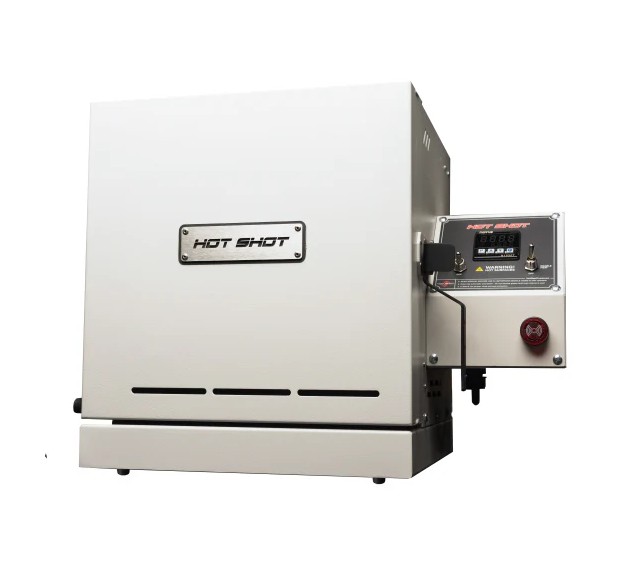
View Hot Shot Kiln
Where to start in the shop
If you are new, a copper circle or square, a sample kit, flux for copper, and a sifter will get a first piece in the kiln. If you already fire and you are hunting a discontinued Thompson color, go straight to vintage enamel and the Thompson opaque and transparent lists. The full catalog is under the listing of enamels.
Questions about a specific jar — leaded vs lead-free, mesh, or whether a color is still in the bin — email sales@e-namels.com or call 937-481-4577. We would rather tell you a color is gone than let you order a ghost.