
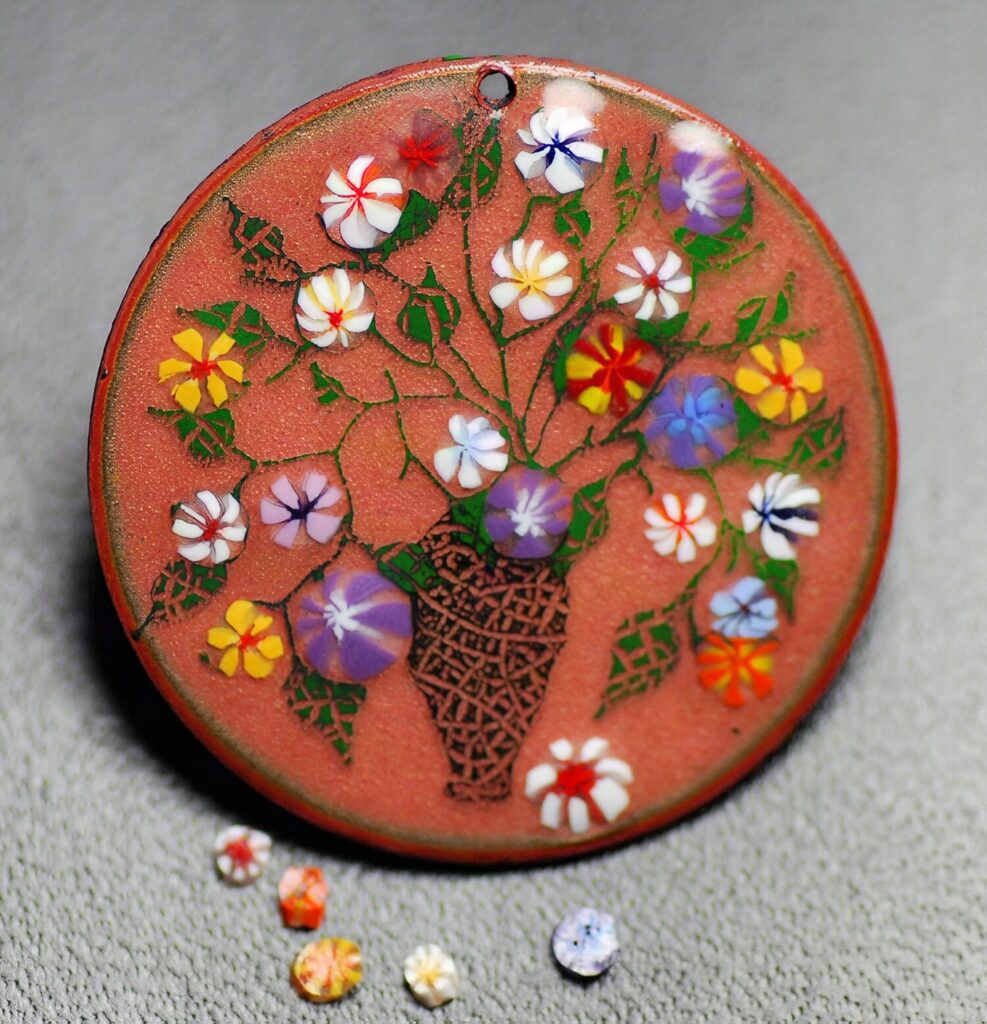
The people who order here are jewelers and studio enamelists. They already have a kiln. What they buy is color, copper, and — when the old one wears out — flux or a sifter. A smaller share comes from studios and classrooms restocking a whole palette at once. This page is about how those customers work and buy, not a roster of names.
The notes below come from what actually leaves the shop: which jars move, which metals, which tools. If you recognize your own bench in one of them, the links go to the same shelves.
Jewelers who build color in cells and hollows
What leaves the shop most often is transparent enamel — especially Ninomiya transparents, with Schauer and Nihon right behind. That mix is what cloisonné and Japanese enamel work eat: fine wires, a copper or silver base, and glass you can see through to the metal or the foil underneath. The same benches order metal foils when they want light bouncing back through a transparent coat, and copper circles, squares, and findings when the piece starts as a blank.
Champlevé is the other way of making a hollow for the glass. Those enamelists cut the design into the metal instead of building wires on top, then buy the heavier copper and fill it. We wrote the techniques up under Enameling 101 if you want the vocabulary. The orders themselves are simpler than the French names: glass in a cell or a trough, fired until it holds.
Painters, and the people still matching Thompson
Not every color order is a cloisonné restock. Sunshine painting enamels usually leave the shop as a set: wet-process color for Limoges-style work, flowers, portraits — anything you paint rather than sift into a cell. Those boxes look different. They carry fewer wire-friendly transparents, more painting colors, and often a kit.
A different set of enamelists came up on Thompson. Thompson opaques and transparents still go out every week, and the vintage pre-1990 leaded line is why a lot of long-time customers are here at all. We are not the factory. Thompson stopped that leaded production decades ago, so the remaining jars are finite. People who need a specific old red, or a flux that behaves the way their notes say it should, order from that shelf until it is gone.
Plenty of studios have moved on to lead-free and still buy from us. Lead-free TE opaque and transparent are among the busiest lists in the shop, with W.G. Ball lead-free, Milton Bridge, and Blythe opaques filling in the rest of a modern palette.
Metalsmiths who need a form, not a chemistry set
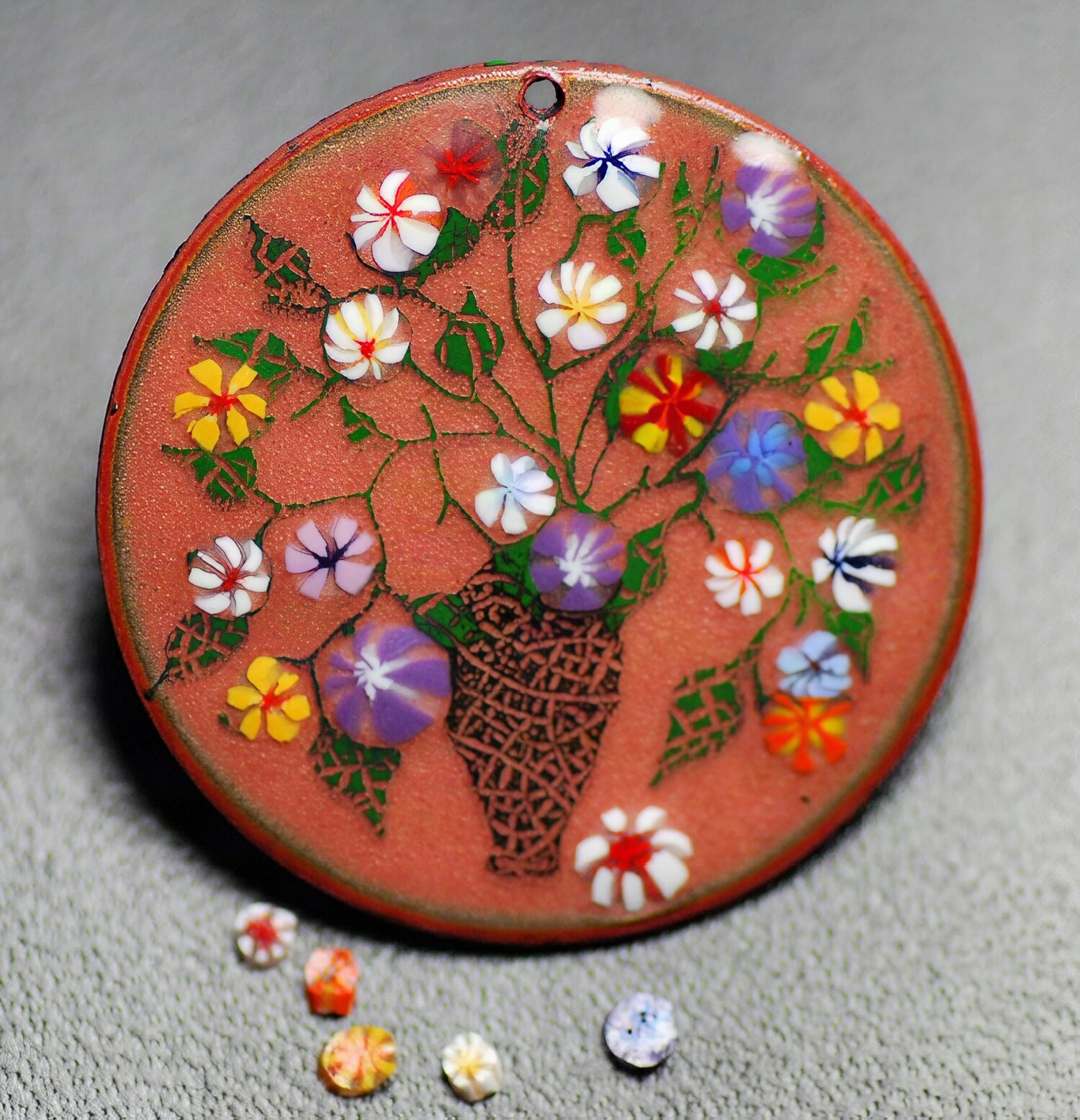
Not everyone wants fifty jars. A lot of orders are two to five lines: a hand-spun copper bowl, a handful of floral wafers, a ready-to-enamel finding. Those customers already know how to fire — they need a shape. Trivets and sifters ride along when something on the bench has worn out. Kilns almost never ride along. People who fire enough to buy color from us already have heat.
Wet-process enamel for copper is the other end of that scale: fewer orders, larger pieces, bowls and panels instead of earrings. Same glass, different size of work.

Classrooms, sample kits, and the restockers
About one order in twenty is a bulk restock — twenty-plus line items. Those belong to teaching benches and small production studios: a sample kit so a class can see the difference between opaque and transparent, then a row of lead-free TE or Ninomiya to keep the kiln busy. Flux is a staple in those boxes. So are sifters and tools. We would rather a teacher test a kit than guess from a chart and end up stuck with a color that will not play with their metal.
Most of the shop’s orders stay in the United States. The ones that leave go to jewelry and enamel studios in Canada, Europe, and Australia — the same craft, different time zones.
If you need a starting shelf
For cloisonné and transparent work, start with Ninomiya transparents, foils, and copper shapes. For painting, start with Sunshine. Matching an old Thompson chip means the vintage enamel shelf. For a lead-free studio palette, TE opaque and transparent. The whole map is the listing of enamels.
Questions about a jar, a mesh, or whether a vintage color is still in the bin: sales@e-namels.com or 937-481-4577. Early Glass on Metal articles about the vintage Thompson line are on the site too, if you work from those old notes.